lola1.jpg

Meet Lola, the sweet Boxer mix belonging to Sutherland SALT Associate Doug Upton and his family. Lola turns two years old in May and has been with the Uptons since she was just a six-week-old pup.

She is a confident, sociable girl who is quick to greet everyone she meets. She spends her weekdays at doggy daycare with her many canine friends, and most days, she returns home worn out and ready to relax.

lola2.jpg

She loves playing tug with her chew toys and enjoys running around the dog park in search of the perfect stick to chew on. She especially enjoys making Doug run after her to take the stick away when he sees that she is no longer chewing, but instead, trying to eat it.

Lola is a very intelligent gal who enjoys her freedom and does not appreciate her family’s attempts to contain her. She has scaled gates to get out of the kitchen and has mastered the art of escaping from her crate—either by simply unlocking the latch or pulling one of the sides loose until she’s able to disassemble it entirely.

This sneaky girl has her own bed but would prefer to sleep with Doug and his wife. Oftentimes, she will wake up Doug in the middle of the night as though she needs to be taken out for a potty break. As soon as Doug is up and out of bed, Lola jumps in and curls up sweetly in Doug’s warm spot.

This clever pup is so very pleased to be January’s Pet of the Month!

lola3.jpg

lola4.jpg

On December 29, 2016, a New York City administrative law judge (ALJ) determined that Sprint’s long distance telecommunications service fees were exempt from the City’s Utility Tax. In the Matter of the Petitions of U.S. Sprint Communications Co., LP, TAT (H) 14-12 (UT) et al. Sutherland represented Sprint in the matter.

  • The ALJ concluded that the Utility Tax enabling statute—which limits the scope of the Utility Tax to transactions occurring within City limits—applies to “transactions” and not “services.” As such, once an exempt transaction has been identified, the exemption applies to the transaction itself plus all revenue associated with the transaction.
  • Applied to telecommunications services, the ALJ determined that exempt long distance telecommunications transactions include not only the charge for the long distance telephone call itself but also charges related to the long distance transaction, regardless of the billing method.
  • Additionally, charges for Internet access are exempt from the Utility Tax pursuant to the Internet Tax Freedom Act, as the City historically did not tax such charges prior to the moratorium on Internet taxes imposed by the Internet Tax Freedom Act.

View the full Legal Alert.

By Robert Merten and Madison Barnett

The San Diego County Superior Court  determined that California’s combined filing regime—which requires interstate taxpayers to use combined reporting but permits intrastate taxpayers to choose between combined or separate reporting—does not violate the US Constitution’s Commerce Clause. The court acknowledged that (1) the interstate and intrastate unitary businesses were being treated differently, and (2) a triable issue of fact existed on whether such differential treatment resulted in discrimination against interstate businesses. The court nevertheless upheld the constitutionality of California’s statute granting intrastate taxpayers the option to file a separate return. The court reasoned that, even if discrimination against interstate taxpayers could be shown, the statute would survive strict scrutiny because the state has a legitimate interest “in preventing the manipulation and hiding of taxable income” by requiring combined reporting “to ensure that all business income from interstate business is accurately accounted for and that it is fairly apportioned.” 

The court’s order was issued on remand from a 2015 Court of Appeal opinion that reversed the trial court’s previous order dismissing the taxpayer’s constitutional challenge. The taxpayer has appealed this order, bringing the case back to the Fourth District Court of Appeal for further disposition. Harley Davidson, Inc. v. California Franchise Tax Board, Minute Order, Case No. 37-2011-00100846-CU-MC-CTL (Oct. 31, 2016), on remand from, 187 Cal. Rptr. 3d 672 (Cal. App. 4th 2015), appeal docketed, Case No. D071669 (Cal. App. 4th Dec. 27, 2016).

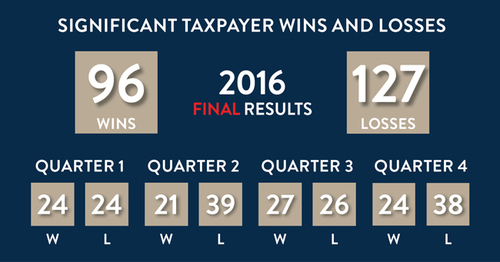
Sutherland SALT releases the fourth edition of the “SALT Scoreboard,” a quarterly publication that tracks significant state tax litigation and controversy developments and tallies the results of taxpayer wins and losses across the country. Our quarterly publication features Sutherland’s observations regarding important state tax decisions and will identify trends by issue, state and forum as they emerge during the year. This issue of the SALT Scoreboard includes Sutherland’s year-end observations for 2016, insights regarding the Ohio Supreme Court’s decision in Crutchfield Corp. v. Testa, and a spotlight on New Jersey. We are closing the book on 2016 and are gearing up for a fresh start in 2017. We have reset our tallies and are tracking the results as they are issued in the new year.

View our Sutherland SALT Scoreboard results from the fourth quarter of 2016!

Q4-SALT-Scoreboard-Graphic_final.jpg

On January 12, 2017, the California Court of Appeal held in a published opinion that a taxpayer passively holding a 0.2 percent interest in a California-based limited liability company (CA LLC) was not “doing business” in the state for purposes of being subject to California’s franchise tax. The court reasoned as follows:

  • Under California Revenue Code Section 23101, “doing business” means “actively engaging in any transaction for the purpose of financial or pecuniary gain or profit” (emphasis added) and the taxpayer did not “actively” engage in any transaction because it had held its investment in the CA LLC for several years prior to the tax year in issue and played no role in the CA LLC’s‎ operations.
  • The CA LLC’s election to be treated as a partnership for federal income tax purposes did not mean that the taxpayer should be treated as a general partner (which would impute the partnership’s activities to the taxpayer and cause the taxpayer to be doing business in California) because a tax election for one purpose does not necessarily control for all taxation purposes in all circumstances.
  • After resolving the case on statutory grounds, the court expressly declined to consider any constitutional issues.

View the full Legal Alert.

On January 5, 2017, a New York State Division of Tax Appeals administrative law judge (ALJ) determined that a taxpayer’s electronic bill payment and presentation receipts constitute “service” receipts and not “other business receipts,” and are properly sourced where the service is performed. In the Matter of the Petitions of Checkfree Services Corp. 

  • New York taxpayers received additional guidance on the important issue of whether online services constitute “service” receipts, and how those receipts should be sourced, for New York corporate franchise tax purposes. 
  • An ALJ found for a taxpayer on this same issue previously. In Expedia, another ALJ confirmed the taxpayer’s position that travel reservation facilitation receipts, and online advertising receipts, constitute “service” receipts that are sourced to the location of performance. In the Matter of the Petition of Expedia, Inc.
  • The ALJ’s analysis in Checkfree largely mirrors the sound analysis in Expedia. Both determinations concluded that the taxpayer performed a “service” under the term’s plain meaning; that a “service” does not require human involvement; that the taxpayer did have some human involvement even though the service had an automated component; and that “service” receipts are properly sourced where performed, which is the taxpayer’s location, not the customer’s location.

View the full Legal Alert.

We are pleased to announce that Sutherland has been named Tax Practice Group of the Year for the third consecutive year by Law360, a nationwide legal news service. The award is given annually to firms that had the biggest wins and worked on the most important deals over a one-year period.

Sutherland’s Tax Practice Group has received numerous awards for client service, most recently being named Tax Advisory Firm of the Year for the fourth consecutive year by Captive Review, the leading trade publication focused on risk management and captive insurance. The group’s attorneys are also regularly featured in a range of “best of” and “who’s who” lists, including The Best Lawyers in America, Chambers USA: Guide to Leading Business Lawyers, The Legal 500: United States and Super Lawyers.

A group of Law360 editors reviewed 619 submissions, of which 80 firms covering 34 practice areas were recognized. Sutherland was one of just five firms selected by Law360 for recognition in the Tax category.

View the full press release.

By Alla Raykin and Eric Coffill

The Massachusetts Appellate Tax Board (ATB) upheld the Commissioner’s assessment, resulting from a denial of a subsidiary’s securities corporation classification for corporate excise tax purposes. Companies classified as securities corporations receive favorable excise tax treatment under G.L. c. 63, § 38B(a), including not being subject to inclusion in the parent’s combined group. The ATB found that classification required either submitting an application before the end of the taxable year or having a classification from the Commissioner from a previous taxable year. The Commissioner denied the classification because the company did not file the required application. The ATB determined that the Commissioner’s prior acceptance of returns without audit did not constitute acquiescence to the classification. Without the classification, the subsidiary should have been included in the parent’s combined reporting group, which resulted in a higher tax liability for both the subsidiary and its parent. Techtarget, Inc. v. Commissioner of Revenue, No. C314725, ATB 2016-481 (Mass. App. Tax Bd. Nov. 18, 2016).

By Zack Atkins and Tim Gustafson

The Washington State Department of Revenue ruled that an out-of-state baker whose only in-state “presence” was its use of in-state independent commissioned sales representatives to solicit orders had substantial nexus with Washington and therefore was subject to the state’s business and occupation (B&O) tax. The taxpayer contracted with the in-state representatives to solicit orders in a territory that included Washington. All orders were sent to the taxpayer outside of Washington for approval. Relying on the state statute and administrative rules in effect at the time and case law standing for the proposition that substantial nexus for B&O tax purposes can be established through the use of independent agents contracted to perform in-state activities, the Department concluded that the independent commissioned sales representatives provided significant services that enabled the taxpayer to establish and maintain a market in Washington. The Department also found that, even though shipment was made by common carrier and title passed to the customers outside of Washington, the taxpayer’s sales to Washington customers occurred in Washington because the baked goods were received there. Commercial law and UCC “delivery” terms, the Department said, are not dispositive for B&O tax purposes. Det. No. 16-0149, 35 WTD 613 (2016).

By Zack Atkins and Marc Simonetti

A federal district court denied a taxpayer’s motion to dismiss a lawsuit brought under the New York False Claims Act (FCA) for lack of subject matter jurisdiction and remanded the action to state court. The relator, an Indiana University professor, alleges that Citigroup violated the FCA by deducting net operating losses on its New York franchise tax returns while knowing that it was not entitled to such deductions under the New York Tax Law. The federal government acquired a substantial interest in Citigroup under its Troubled Asset Relief Program. While IRC § 382 generally limits net operating loss carryforwards that can be deducted after an “ownership change,” the IRS issued multiple notices indicating that it would not treat such acquisitions as ownership changes. The relator claims that Citigroup underpaid its tax liability because the IRS’s notices are invalid and therefore cannot be relied upon or, alternatively, that the notices were never incorporated into the New York Tax Law. The federal district court observed that while Citigroup’s arguments for dismissal—all of which were grounded in state law—were “potentially meritorious,” the lawsuit “does not truly present a federal question.” The lawsuit calls into question the validity of the IRS’s notices but the court held that the relator lacks standing to challenge the validity of the notices. Because it could conceivably resolve the relator’s FCA claim without deciding whether the IRS’s interpretation of IRC § 382 was arbitrary and capricious, the court concluded that the relator’s complaint did not necessarily raise a federal issue and therefore remanded the case to state court. State ex rel. Rasmusen v. Citigroup, Inc.