Meet Luna, our newest and youngest addition to this year’s SALT Pet of the Month family! At just eight weeks old, this five‑pound “Cavapoo,” a mix of King Charles Cavalier and Poodle, has already captured hearts in the family of Mike Kelley, Global Tax Counsel at Microsoft.

Her name was not chosen lightly. After serious family debate at the kitchen table, and several rounds of voting, a unanimous decision was finally reached. Luna officially earned her title, and like her namesake, she shines with confidence.

Luna is in the early stages of crate training, though she seems to view it less as a lesson and more as a negotiation. Armed with oversized puppy eyes, she appears to be running a parallel training program, one focused entirely on her humans.

We are delighted to welcome Luna to our SALT Pet of the Month family. Welcome, Luna!

We’re pleased to share that Greg Matson, the former Executive Director of the Multistate Tax Commission (MTC), has joined our SALT team as Counsel.

Greg has decades of experience working on complex state tax issues while representing taxpayers and states. That experience, coupled with his skills as an advocate and advisor, will form the basis of Greg’s counsel to our clients.

“Greg is one of the most respected voices in the state tax community,” said Jeff Friedman, Head of the SALT team. “I am absolutely over the moon to have my friend of 25 years join us. Greg is a humble advisor – often guiding a position without taking the credit or limelight. He is a careful listener and a thoughtful lawyer. I am looking forward to admiring his representation of our clients in the years ahead.”

To read the full press release, visit this link.

This week, SALT Partners Michele Borens, Jeff Friedman, and Tim Gustafson are pleased to present at COST’s 2026 SALT In A Digital World Workshop, where leading practitioners will unpack the key SALT issues that affect everyone using technology in their operations.

Our partners will explore how these developments are playing out across the SALT landscape. Panels include:

  • Litigating the Digital Frontier: State Tax Cases Driving Change – exploring significant state tax litigation and regulatory actions impacting digital platforms, online marketplaces, social media advertising, and emerging technologies as well as cases challenging nexus standards, sourcing rules for digital services, and the constitutionality of taxes on data and digital advertising.
  • Transfer Pricing in the Digital Age: State Tax Challenges – exploring the unique transfer pricing issues arising in the digital economy, from valuing intangible assets such as algorithms and user data to allocating revenue from targeted advertising and cloud services.
  • Single Sales Factor: Simplicity or Distortion? The Fair Apportionment Debate – examining the evolution of single sales factor, its impact on multistate businesses, and the controversies surrounding distortion, internal and external consistency, and alternative apportionment petitions.

We look forward to connecting with fellow practitioners and sharing practical insights from the front lines.

Register to join us!

Calling all trivia fans! Don’t miss out on a chance to show off your SALT knowledge!

We will award a prize for the smartest (and fastest) participant.

This week’s question: California is currently considering a proposed bill that would take away what tax election?

E-mail your response to SALTonline@eversheds-sutherland.com.

The prize for the first response to today’s question is a $25 UBER Eats gift card. This week’s answer will be included in our SALT Shaker Weekly Digest, distributed on Saturday. Be sure to check back then!

Members of the firm’s SALT team will be sharing insights on apportionment, sourcing, and key litigation trends at several industry events this week.

SALT Partner Tim Gustafson will present at the California Taxpayers Association’s 100th Annual Meeting of the Members in Sacramento, CA. His panel will explore evolving apportionment rules and their impact on taxpayers, including emerging issues in gross receipts classification, market‑based sourcing, and sales factor apportionment.

Register to join here.

Also this week, Partners Michele Borens and Jeff Friedman will join the speaker lineup at the TEI Seattle Chapter’s Tax Forum on Wednesday, February 25. Their session will examine strategies for sourcing receipts from modern digital commerce, comparing traditional apportionment methods with newer market‑based sourcing approaches. Michele and Jeff will also discuss key considerations in cost‑of‑performance states, along with trends in look‑through sourcing and alternative apportionment.

Find out more here.

Finally, on February 26, Counsel Charles Capouet and Associate Periklis Fokaidis will present a comprehensive review of the long‑standing SALT Scoreboard publication and the most significant state tax decisions from across 2025. With a particular focus on Q3 and Q4 developments, their session will recap key case opinions, analyze emerging litigation trends, highlight notable late‑year activity, and compare 2025’s results to prior years’ case tallies.

Register here.

On February 26, join Eversheds Sutherland attorneys Charles Capouet and Periklis Fokaidis for a comprehensive review of the long‑standing SALT Scoreboard publication and the most significant state tax decisions from across all of 2025, with a particular focus on Q3 and Q4 developments.

In addition to recapping the year’s key case opinions, Charles and Periklis will analyze emerging litigation trends, discuss notable late‑year activity, and compare 2025’s results to prior years’ case tallies.

Register here.

The taxpayer, a fleet management company that leases fleets of commercial vehicles to businesses, used leases containing a terminal rental adjustment clause (TRAC). Under these leases, the lessee paid estimated monthly rent based on the projected residual book value of the vehicle at lease termination. When the lease ended, the estimated rent was retrospectively adjusted to determine the actual rent owed.

At lease commencement, the taxpayer reported and remitted sales tax based on the estimated rent schedule. If the actual rent was lower, the taxpayer refunded the excess rent and the related sales tax to the lessee and then claimed credits on its sales and use tax returns to recover the overpaid sales tax.

The Department of Taxation and Finance (Department) audited the taxpayer and concluded it was not entitled to take such credits, resulting in additional sales tax due of nearly $3M. The Department’s position was that the sales tax liability was irrevocably fixed at the inception of the lease. The Tax Appeals Tribunal agreed with the Department.

On appeal, however, the appellate court ruled in the taxpayer’s favor. The court held that, in TRAC leases, initial payments are provisional estimates and the final consideration is not determined until the lease concludes. Accordingly, amounts ultimately refunded to lessees were never definitively contracted to be paid and therefore should not have been included in the sales tax base.

In re Gelco Corp. v. State of N.Y. Tax Appeals Trib., No. CV‑24‑1376 (N.Y. App. Div. 3d Dep’t Feb. 5, 2026).

Calling all trivia fans! Don’t miss out on a chance to show off your SALT knowledge!

We will award a prize for the smartest (and fastest) participant.

This week’s question: Which southern state’s Senate recently passed bills that would reduce the personal income tax?

E-mail your response to SALTonline@eversheds-sutherland.com.

The prize for the first response to today’s question is a $25 UBER Eats gift card. This week’s answer will be included in our SALT Shaker Weekly Digest, distributed on Saturday. Be sure to check back then!

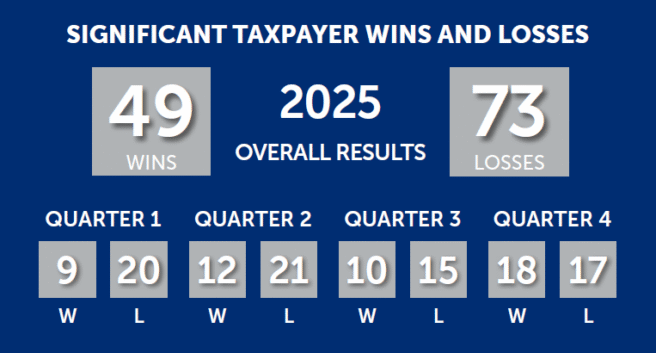
This is the fourth edition of the Eversheds Sutherland SALT Scoreboard for 2025. For an entire decade, we have tallied the results of what we deem to be significant taxpayer wins and losses and analyzed those results.

This edition includes discussion of exemption certificates and domicile, as well as a spotlight on Washington cases.

Dive into the Eversheds Sutherland SALT Scoreboard for the fourth quarter of 2025 now!

In this episode of the SALT Shaker Podcast, Partners Jeremy Gove and Chelsea Marmor unpack one of SALT’s highly discussed and fast‑evolving areas: digital services taxes.

Their conversation breaks digital services taxes into four distinct frameworks, helping listeners understand how states and localities are approaching the taxation of digital activity in different ways. The discussion covers Maryland’s digital advertising tax, Washington’s expansion of its sales tax to digital services, Chicago’s social media amusement tax, and proposed data taxes – such as those in New York – that would impose tax based on the volume of consumer data companies collect and maintain.

In closing, they wonder if the Winter Olympics are overrated or underrated.

For questions or comments, email SALTonline@eversheds-sutherland.comSubscribe to receive regular updates hosted on the SALT Shaker blog.

Listen now:

Subscribe for more: