On January 8, 2020, the Court of Appeal of Louisiana partly affirmed and partly reversed a district court’s rejection of the Louisiana Department of Revenue’s franchise tax audit changes for a taxpayer that owned and operated, through subsidiaries and an affiliate, casinos and horse-racing facilities. Following an audit, the Department made numerous adjustments to the taxpayers’ franchise tax capital base. After paying the tax and interest, the entities sought a refund for the taxes paid under protest. The district court granted summary judgment to the taxpayer on multiple issues, which the Department then appealed to the appellate court.

First, the court held that the district court erred by determining that there was not a genuine issue of material fact regarding whether fees for management services should be apportioned to Louisiana. Because the parent utilized and paid employees in Louisiana, even though the management agreements stated that the employees were performing services for the subsidiary, there was a question as to whether the employees were employed by the parent or the subsidiary while rendering services in Louisiana.

Second, the court upheld the district court’s determination that the taxpayer’s adjustments to its surplus and undivided profits were proper because the adjustments were made pursuant to the equity method of accounting reflecting the fair value of the investments.

Third, the court held that the district court erred in finding that the Department improperly characterized the parent’s funds furnished by its affiliates as borrowed capital included for purposes of computing franchise tax. The taxpayers could not avoid the funds’ characterization as borrowed capital because they could not present any evidence of restrictions on the parent’s use of the funds in its concentrator account, of which it had exclusive control. The taxpayers also could not show that the funds fell within an exception because there was no evidence that the moneys were actually segregated by the taxpayer (e.g., a separate bank account, rather than a mere account entry).

Fourth, the court held that the district court erred by determining that there was not a genuine issue of material fact regarding whether the parent could include losses suffered by its wholly-owned partnership for purposes of the franchise tax business ratio. The court concluded that the taxpayers failed to present evidence to sufficiently establish that the partnership’s losses were “revenues from a partnership” that could be included in the parent’s business ratio. Boyd Louisiana Racing, Inc. v. Bridges, Dkt. Nos. 2018 CA 1309 et seq. (La. Ct. App. Jan. 8, 2020).

In a recent private letter ruling, the South Carolina Department of Revenue held that software subscription services are tangible personal property subject to sales and use taxes. A software company that provides a cloud-based business management and billing platform for medical equipment suppliers requested the letter ruling to determine whether its subscription charges were subject to the state’s sales and use taxes. Applying South Carolina’s statutory definition of taxable “tangible personal property,” which includes services such as communication services, and the Department’s regulations, which provide that database access transmission services and on-line information services are taxable communications services, the Department concluded the company’s software subscription services are taxable. Specifically, the Department found the company to be an “application service provider,” a company that provides its customers access or use of software on the company’s website, and concluded the company’s subscription services were similar to those found subject to tax in the Department’s prior administrative rulings.

SC Private Letter Ruling No. 20-1.

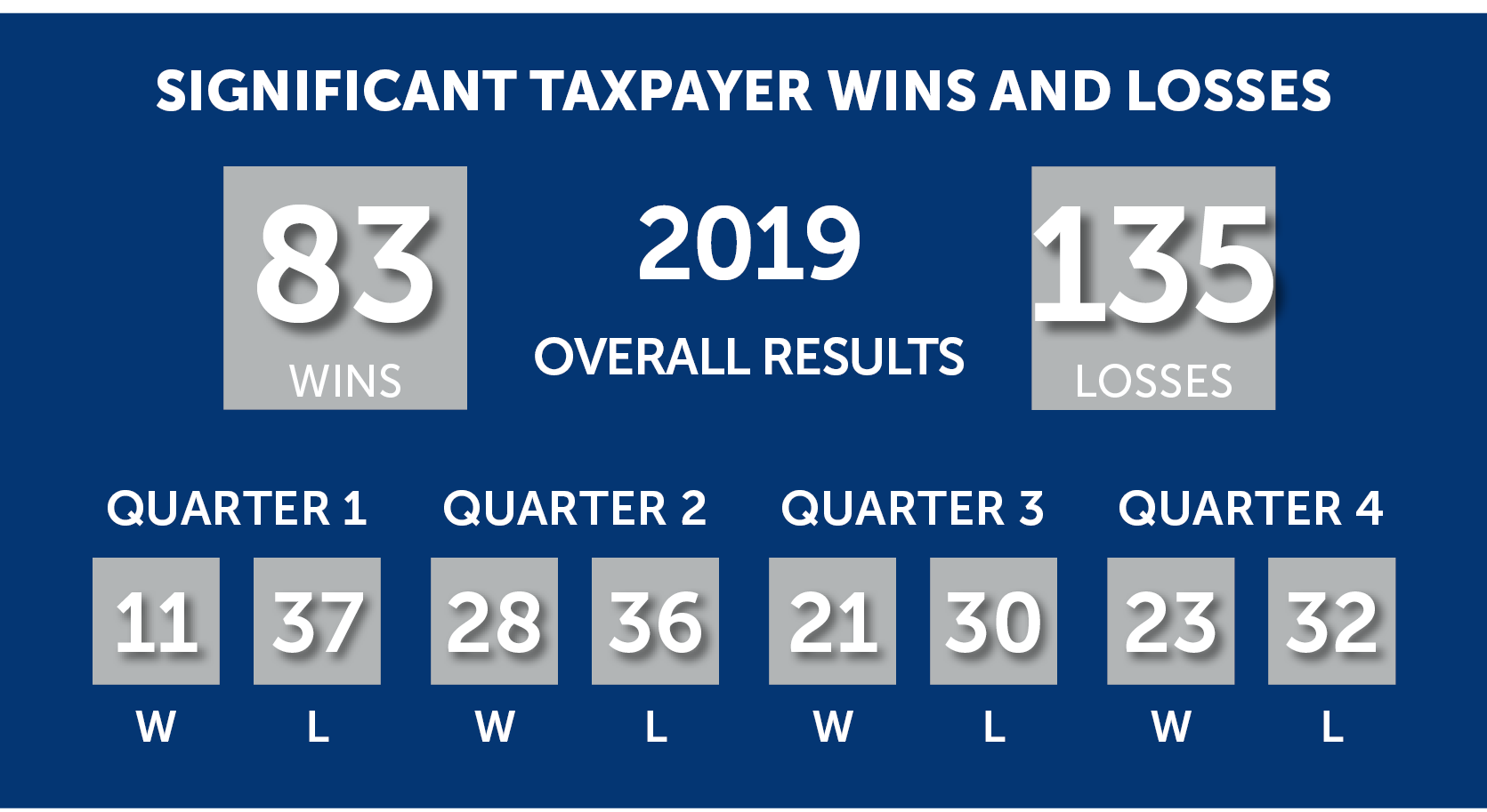
This is the final 2019 edition of the Eversheds Sutherland SALT Scoreboard. Since 2016, we have tallied the results of what we deem to be significant taxpayer wins and losses and analyzed those results. This edition of the SALT Scoreboard includes a discussion of the Wisconsin Court of Appeals’ decision regarding “look through” receipts sourcing, insights regarding the retroactivity of tax credit limitations and the scope of Public Law 86-272, and, to end the year on a high note, a spotlight on taxpayer wins. Check out the full scorecard here.

The New York State Tax Appeals Tribunal (TAT) held that Apple improperly collected sales tax on sales of Apple computers and iPads because it discounted the purchase price by the amount of gift cards it gave to customers as part of a back-to-school promotion.  Under New York tax regulation, the amount of a discount of a store-issued coupon, where a third party does not reimburse the store, is not included in taxable receipts. 20 NYCRR 526.5(c)(3). Moreover, according to guidance issued by the Division of Taxation, gift cards are not subject to sales tax at the time of transfer; instead, sales tax is imposed when the gift card is exchanged, in whole or part, for an item subject to sales tax. See NY St Tax Bulletin TB-ST-806. The TAT agreed with the New York State Division of Tax Appeals that Apple did not meet its burden of proving that the promotional gift card was purchased at the same time as the qualifying device. Rather, the promotional materials implied that receiving the gift card was the direct consequence of purchasing a qualifying device. As a result, the TAT concluded that Apple should have charged sales tax on the full price of the device without discounting for the value of the promotional gift card.

Apple Inc., DTA 827287 (N.Y.Tax.App.Trib. 2019).

On January 29, 2020, the Maryland State Senate’s Budget and Taxation Committee heard testimony on Senate Bill 2, which would create the Digital Advertising Gross Revenues Tax. The tax would be imposed on a taxpayer’s Maryland gross revenues from digital advertising services at up to a 10% rate. After brief introductions by the bill’s sponsors – Senators Miller and Ferguson – the Committee heard testimony from an additional twenty-one witnesses. An archived video of the hearing is available here.

Senators Miller and Ferguson emphasized that the purpose of Senate Bill 2 is to fund the state’s public education initiative. It is one of numerous bills being considered to pay for this initiative.

The most notable witness in support of the bill was Professor Paul Romer, an economist who wrote a New York Times opinion last year that advocated for a tax on targeted digital advertising. However, his comments were dedicated to combating targeted advertisements via this tax, rather than on bringing in additional tax revenue for the state of Maryland from broadly taxing all digital advertising.

Read the full Legal Alert here.

Former Tax Executives Institute (TEI) President Neil Traubenberg and his wife Joan recently added a new member to their family, Bo, a one-year-old Whoodle (Wheaton Terrier/Poodle mix).

When their daughter Lauren was looking for a new dog, they brought their eight-year-old Schnoodle, Thai, to see if he would get along with the new puppy. Well Thai and Bo became instant friends, and it was clear to the family that these two dogs belonged together. So, the Bo/Thai or Thai/Bo connection was born. And, Lauren did, in fact, go home with her own German Shepherd puppy.

Tending more to the poodle side when it comes to appearances, Bo’s jet black exterior makes her nearly invisible on summer nights. In the winter, she sticks out like a sore thumb in the Wisconsin snow. In the year since Neil and Joan brought Bo home, she has grown from half Thai’s size to more than double his size.

As a larger dog, Bo needs a little more exercise and takes regular walks with Neil. She loves to find a large stick that she can carry and use as her scepter so she can put on a regal walk for all to see. She also loves when her “cousins” Frankie and Greta come over to play. They will run themselves ragged in the backyard. Just when you think someone is going to get hurt, they roll in the grass together with their tongues hanging out.

She is still a puppy though, and while she has gotten past most of her problems of chewing anything she could get her paws on, she made it her goal to chew through all four corners of her new dog bed this year.

We are thrilled to feature Bo as our January Pet of the Month!

The owner of an NBA arena is appealing an Ohio commercial activity tax (CAT) determination arguing that gross receipts from ticket sales of third-party events hosted at the arena are not attributable to the owner. When the arena was not being used by the Cleveland Cavaliers, the owner rented the facility to third-parties who host various entertainment events, such as concerts. As part of these arrangements, the arena owner sold tickets on behalf of the third-parties in return for certain fees or percentages of the net ticket sales. The Ohio Tax Commissioner determined that the gross amount of these ticket sales was attributable to the arena owner for purposes of the CAT because the owner held these funds in its bank account (regardless of any subsequent transfer to third-parties). In its appeal to the Ohio Board of Tax Appeals, the arena owner argues that temporarily holding the proceeds of ticket sales does not amount to a realization of gross income for purposes of the CAT and that these funds are statutorily excluded from its gross receipts under R.C. 5751.01(F)(2)(1) because it was merely an agent of the third-parties.

Notice of Appeal, Cavaliers Holdings LLC v. Jeffrey A. McClain, No. 2020-55 (Ohio Board of Tax Appeals).

Earlier this month, Maryland State Senators Miller and Ferguson introduced Senate Bill 2, which would tax Maryland digital advertising service gross revenues at up to a 10% rate. Earlier today, the Department of Legislative Services issued the Fiscal and Policy Note for the proposal, which estimates up to $250 million of revenue in the tax’s first full year. Tomorrow, January 29th, the Maryland State Senate’s Budget and Taxation Committee will hear testimony on this bill during its 1:00 p.m. meeting in Annapolis. A live stream of the hearing can be found here by clicking the red “Live!” link next to “Budget and Taxation Committee – Bill Hearing” (the button will appear once the hearing has begun). An archived video of the hearing can be viewed here.

The California Court of Appeal for the Fourth Appellate District upheld a trial court’s judgment that a plaintiff lacked standing to challenge the sales tax practices of a technology company because she did not establish the existence of an economic injury. The plaintiff purchased cellphones from the technology company at a discounted price as part of bundled transactions along with telecommunications provider service contracts. In accordance with California law, the technology company chose to collect and remit sales tax from customers based on the unbundled price of these cellphones. Although the technology company was not required to include the unbundled price or the method of calculating the sales tax on customer receipts, the plaintiff alleged that by not adequately disclosing to customers that the sales tax for these bundled transactions would be calculated based on the unbundled price the technology company violated California’s Unfair Competition Law and Consumer Legal Remedies Act. Relying on a previous court of appeal decision with nearly identical facts, the court found that a plaintiff whose only claimed harm is the denial of the opportunity to shop around must show that she could have purchased the same product from another retailer without having to pay the sales tax on the unbundled price. Therefore, because the plaintiff did not present evidence that she could have purchased the same cellphones from another retailer in bundled transactions without paying sales tax on the unbundled price, the court concluded that the plaintiff lacked standing. Adame v. Apple Inc., Dkt. No. D073567 (Cal. Ct. App. Dec. 31, 2019) (unpublished).

On January 13, 2020, the Washington Court of Appeals upheld the Washington Department of Revenue’s retailing characterization of taxpayer’s provision of online access to information in a digital research library. Therefore the taxpayer’s service was subject to Washington sales tax and the higher business and occupation (B&O) tax rate. Gartner, Inc. v. Washington Department of Revenue, No. 51637-3-II (Wash. Ct. App. Jan. 13, 2020).

The taxpayer is a global information technology firm that sells online subscriptions to its research library. For purposes of Washington sales tax, the Department took the position that the taxpayer’s research service was subject to sales tax as a “digital automated service” and subject to the higher B&O tax rate as “retailing.” The court analyzed the taxpayer’s digital library and related services and found that, although the files, data and other information in the library constituted digital goods, because a subscriber’s access or use of a digital good is facilitated by software, the product is a digital automated service. The court thus held that the search functions, recommendations of “trending” news and the taxpayer’s customized client portal subsite rendered access to the library a digital automated service.

The court also rejected the taxpayer’s argument that the taxpayer’s product should be excluded from the definition of a digital automated service due to the application of “human effort.” The court found the exclusion inapplicable because the human effort used to create the product did not occur in response to a customer’s request for the service. Customers were not permitted to request taxpayer’s employees to conduct specific research requests. Instead, employees of the taxpayer identified topics for research and create content for customers based on trends, forecasts and “client requests in the aggregate.”

Further, the court rejected the taxpayer’s arguments under the “true object” test and the Internet Tax Freedom Act (ITFA). The court rejected the taxpayer’s true object argument on the basis that digital library access and related services can be purchased separately from other consulting and advisory services that are provided by the taxpayer to its customers. Under ITFA, the taxpayer argued that its services would be subject to the service B&O tax if it sent its research reports by mail or CD and that the Department’s characterization violated ITFA because it resulted in a higher tax rate on services that were “electronically delivered.” The court disagreed, finding that reports sent via tangible format to be a significantly different service than the taxpayer’s online research portal.